Some pretty interesting information has surfaced in a drivers update at Laptopvideo2go (via Videocardz). Apparently the .inf file to the driver update that contains support for two Maxwell powered Quadro Professional GPUs has been posted, along with a new nomenclature. This means that the video industry will soon be able to utilize the power increase and efficiency offered by the Maxwell architecture and get to enjoy an unfortunate nomenclature.
Nvidia Driver Update Reveals Quadros with Maxwell Cores – Mobility Included
Now the biggest difference between Quadro and your mainstream Nvidia cards is the double precision floating point operation per cycle ratio. For Quadro variants this number is 1. Which means the card can process 1 double precision floating point operation per cycle per core (which is a 1/2 ratio). In sharp contrast a Fermi’s double precision floating point performance (aka FP64) is 1/8th of FP32 ( Single Precision). A Kepler 780′s FP64 performance is 1/16 of FP32 and finally a Maxwell 750′s FP64 is 1/32 of FP32. I am sure you can see a trend here. Basically if you want that sweet 1 to 2 ratio, you are going to have to pay the premium and quite a big one at that. As you can imagine, a Maxwell core inside a professional GPU will make quite a performance jump. VC managed to locate the IDs of the GPUs and alot them to the correct nomenclature:
NVIDIA_DEV.0FF3 = NVIDIA Quadro K420 (GK107)
NVIDIA_DEV.13BB = NVIDIA Quadro K620 (GM107)
NVIDIA_DEV.13BA = NVIDIA Quadro K2200 (GM107)
NVIDIA_DEV.11B4 = NVIDIA Quadro K4200 (GK104)
NVIDIA_DEV.103C = NVIDIA Quadro K5200 (GK110)
So we are looking at 2 Desktop and 1 Mobile (K2200M) Professional GPUs with Maxwell Architecture. Both feature the GM107, which is somewhat of a let down because that means we are looking at the first generation Maxwell Architecture as opposed to the second generation. It is also somewhat obvious I guess, because Nvidia would surely want to utilize the first generation architecture in the Professional market as well instead of just skipping it and going against the Profit Motive. That would also make these Maxwell Quadros the 750/750Ti’s of the professional world, with the actual Maxwell Quadro Flagship and the equivalent of the Quadro K6000 coming later.
After a long wait, we have finally received the first authentic confirmation of the Nvidia Flagship GPUs set to release in 2014. To be clear, we are definitely not looking at 20nm GPUs, instead its the same 28nm node with the advanced Second Generation Maxwell Architecture. The source of the leak is the insanely reliable Sweclockers.com.
Nvidia Maxwell GTX 880 and GTX 870 on the 28nm Node Landing in November
We had previously received estimation from Sweclockers of an expected release date of Oct/Nov but now they have confirmed it. This is big news people. This means that we are not going to be skipping the year 2014 entirely after all and will be receiving a new performance class form Nvidia based on the 28nm Maxwell. We have already seen the engineering sample of the Maxwell GTX 880 and this more or less confirms that we are going to be seeing leaked benchmarks very very soon. The core that will be housed is the GM204 circuit which will be used in the highest end GPU released (Geforce GTX 880). Now since reports indicate that Nvidia has completely scrapped the GM100 chips, we are looking at second generation Maxwell Architecture.
Nvidia is targeting the holiday season and is allegedly counting on a completely monopolistic playing field. Since the only GPU that AMD will be releasing (so far) is the Tonga GPU which is not the same performance class as the Maxwell flagships, Green will enjoy an uneven playing field. If the GTX 750 and GTX 750 Ti (and thats just the first generation Maxwell) are any indication we are looking at an impressive performance boost as compared to the Kepler flagships GTX 780 and 780 Ti. From previous leaks regarding the 880 we know that the GM204 could ship with 8GB of GDDR5 memory although the November arrivals could be in 4GB variants with 8GB variants following after (Profit Maximization). We might even see an ARM core onboard the GPU as well although that is pure speculation based on the blurred out parts of the engineering sample of the GTX 880 we spotted before. AMD’s Tonga GPU will be arriving in August or September of 2014. It looks like the dry season of GPUs is finally over because in a few months its about to rain Red and Green Next Gen GPUs (albeit still at the 28nm node).
Our chinese friends over at Mydrivers have just unveiled pictures of the Maxwell flagship Geforce GTX 880. The pictures clearly show the die which has been manufactured by TSMC, and not only that it shows the TDP as well as other minute details. So enjoy this very significant (and the first real leak) of the possible GTX 880 Maxwell Flagship.
Nvidia Maxwell Flagship Geforce GTX 880 Spotted – 375W of TDP and 8GB of Memory
Alright first thing is first. You can clearly see 8 Hynix memory chips on the picture so we are looking at 8GB of vram and possibly 16GB of vram for professional counterparts. The code 1421A1 can be seen clearly which means that its i s the A1 revision of the die which was manufactured in the first 21 weeks of 2014, which means May 19-25. Basically you are looking at a completely fresh die that has been rolled from TSMC (notice the word Taiwan? that means it is TSMC). We can also see 1 Eight Pin and 2 Six Pin Connectors which amounts to a grand total of of 375W (PCI-e: 75W, 2x6Pin: 75Wx2 and 8 Pin: 150W). Actually 2 Eight pin power connectors can achieve the same load but this is done to increase stability and take of most of the load from the PCI-E. So we could see TDP of around 300-375W.
The memory code is SKHynix H5GQ4H24MFR so we are looking at a memory configuration of upto 16GB on professional Quadro counterparts (which this card could very possibly be). Ofcourse this could be the GM204 core for all we know but the most interesting thing I find is that a very big portion of the GPU is actually pixelated out. So we are hiding something that not even NDA breakers dare reveal. What could that possible be? Well an obvious guess would be an ARM core and that seems likely because when we saw the Darbee variants the ASIC was placed in approximately the same PCB space. The card is completely barebones and reeks of being freshly baked.
Also the PCB appears to be freshly made as well, since I can still see the residue of the printing on the top connectors. Also it goes without saying that the core could very easily be GM204 since I am primarily quoting mydrivers when I say its a GM210. We cannot be sure whether this core is based on the 28nm fab with an ARM core (in which case it would be second generation) or the 20nm fab (in which case technically it would be third generation). Although realistically speaking we are most probably looking at the 28nm node with an ARM core. Now though it is technically possible to compare die sizes by comparing pictures, I don’t want to go into it because that would mean changing the perspective slightly of the die shot which could result in erroneous results. Also this appears to be a very early prototype which is obvious from the green PCB, and since we learned that nvidia has recently shipped the loadboard for the GM2xx circuits this is going to be the testing playtoy of Nvidia engineers. Needless to say, we are going to be hearing about the Geforce GTX 880 Maxwell flagship (or the Quadro variant) very soon.
RDT is bringing its 2011 socket Monster to the market. This is aimed at content professionals looking to get into 4k rendering or upgrading. This PC is built to dominate, packing all the best components in an aesthetically pleasing Corsair Carbide Air 540 case offering ultimate airflow for cooling.
Within this build you have everything to keep your system running swiftly and cool. RDT does offer complete custom watercooling systems if you are not happy with the Corsair H110 AIO. All parts chosen are for optimal performance. If you think there is something you don't need, I am happy to help choose what is ideal for you.
The current specifications are:
Intel Core i7-4960x Extreme 3.6Ghz 6-Core CPU
32GB G.Skill 2400Mhz DDR3 RAM 4x8GB
ASUS P9X79-E WS 2011 Socket Motherboard
EVGA GeForce GTX 780Ti 3GB x2 SLI
Samsung Evo SSD 250GB x2 RAID 0
Wester Digital 4TB x2
Corsair H110 CPU Cooler AIO
Seasonic 1000w Platinum PSU
Corsair Air 140mm Quiet Edition LED Fans
Corsair Carbide Air 540 Case
Windows 8.1 Pro
Complete Build Cost:
$5,999 AU
(includes assembly/install)
All builds are completely customisable and open for any budget.
If you want to contact RDT please feel free to call between the hours of 9am-8pm AEST.
deon@robertsondt.com
Ph: 0426279566
Recently there has been a lot of news surrounding Nvidia’s GTX 880 GPU based on the next generation Maxwell architecture. We found through shipping details that the card will feature a 256 bit bus as compared to 256 or 512bit. The details received only specifying a high end Maxwell GM204 housing a 256 bit wide bus. Well folks at Sweclockers.com have sent us something very interesting. They have reportedly received details regarding the release dates of Nvidia’s desktop GeForce GTX 800 series. The launch is expected to take place in the fourth quarter this year.
Nvidia GeForce GTX 880 and GTX 870 Now Expected To Arrive Sometime Between October-December
Sweclockers is reporting that Nvidia’s GeForce GTX 880 and GTX 870 are now expected to be with us somewhere around the fourth quarter this year. This places the arrival schedule for the desktop GPUs in the period between October to December. The knowledge comes to the website from partner manufacturers of Nvidia. This upcoming launch of the cards will now mark the starting of the 800 series of desktop GPUs. Of course, the GTX 800 will be based on second generation Maxwell architecture. In addition, the new model series is still to be based on the 28 nm manufacturing technology. This is because even though TSMC has begun volume production on the 20nm node for everyone, the process is facing maturation problems for high performance ASICs like the GM204, but this is expected to start from sometime next year. In addition, it has also been learnt that Nvidia has canceled the production of GM100 chips and is now focusing completely on GM200 instead. These GPUs are still using the 28nm fabrication process.
I think we can now safely conclude that 20nm GPUs will come in 2015. This series is to become the Intermediary GPUs that we have been talking about for a long time. It is possible that one or two GPUs in the Geforce 800 Series lineup are 20nm but that is a long shot and will only happen in mid-late 2015. Another thing to add is that this second generation of Maxwell Architecture is speculated to feature ARM cores which could be a potential game changer. So 28nm Maxwell is coming, possibly with ARM cores but 20nm remains as far away as ever.
We have just received some really pleasant news on Nvidia’s Maxwell Architecture, the 20nm side of things to be exact. The new report basically mentions a few things; firstly, that the GTX 880 will be more powerful than the GTX 780, something common sense derives easily. And secondly that the GTX 880 will be cheaper than its 700 Series Counterpart. Now this, is the really interesting bit.
20nm Maxwell GTX 880 and GTX 880 Ti to be Cheaper and More Powerful than 700 Series Counterparts
Slowly but surely, news about 20nm GPUs is beginning to leak from different sources. We learned that TSMC has finally started 20nm Volume Production (for Nvidia and AMD) and that we cant really expect 20nm lineups before 2015 or late 2014 at the earliest. Now our source EXPReview.com is stating that the GTX 880 and GTX 880 Ti will be much more powerful but cheaper than the GTX 780 and GTX 780 Ti respectively. Now, take this with a pinch of salt. These guys have never failed us in the past so I owe it to them to not label it as a rumor. However, contra revenue isn’t really Nvidia’s de facto standard (point Titan Z) to put it bluntly and incurs slight disbelief on my part. Ofcourse it could simply be that production cost has been decreased, but that once again, makes no sense.
Now heres the funny thing. Reports in the past have indicated that there is a chance of a high end 20nm Maxwell Card in late 2014. This card could be the 20nm GTX 880 Maxwell. The chances are very slim, but the fact remains that unless Nvidia brings out intermediary Maxwell cards based on the 28nm node it could loose market share to AMD who is already working on intermediary GPUs. There is also the fact that TSMC has begun volume production for both parties, so a 20nm Flagship from Nvidia is not out of the question. I for one would be really happy to see Nvidia price the Maxwell Flagship GTX 880 lower than the GTX 780, because it would turn the heat on AMD. And that means much more fierce competition, and though that would suck for both companies (Game Theory), for us consumers, nothing could be better.
AMD FirePro™ Ultra Workstations are packed with cutting-edge GPU technology and deliver the ultimate real-time 4K experience for Engineering and Creative professionals.
AMD has worked closely with select partners to bring a new generation of powerful workstations to market. AMD FirePro Ultra Workstations deliver the computational and graphics processing performance to take full advantage of the next revolution in display technology: Ultra High Definition or Ultra HD monitors feature four times the resolution of HD (3840 x 2160 pixels), often referred to as “4K”, and can transform engineering and creative workflows by providing much higher visual fidelity and precision, freeing your models and content from virtually any pixel raster and getting yet another step closer to working with eye-limiting resolutions.
THE VISUAL SUPERCOMPUTER FOR YOUR DESK
With up to four high-end AMD FirePro™ W9100 graphics processing units (GPUs) and support for OpenCL™ 2.0, creative and engineering professionals can now access over 20 teraflops of computational power1see new footnote and close to 16 billion triangles per second of geometry performance. Combined with an industry-first 16GB GDDR5 of dedicated graphics memory and 2816 Stream Processors per GPU, an AMD FirePro™ Ultra Workstation is a Visual Supercomputer for your desk.
With an AMD FirePro Ultra Workstation, you can now master even the most demanding 4K workflows, from CAD, Engineering Analysis and Digital Prototyping to 3D animation and effects creation as well as video editing and post-production.
AMD FIREPRO™ ULTRASTATION SYSTEM PERFOMANCE: QUAD-GPU CONFIG
Over 20 teraflops of GPU compute
Close to 16 billion triangles per second
Up to 64GB of dedicated graphics memory
Up to 200 Megapixels of resolution (across 24 UHD/4K displays)
Each AMD FirePro W9100 GPU is capable of driving up to six UHD/4K displays using the DisplayPort 1.2 standard, making it possible to generate a total of 200 Megapixels across 24 displays, in a Quad-GPU configuration, all from a single Ultra Workstation!
Computex is just around the corner and we are starting to see some new products emerge. EVGA has announced a line up of the NVIDIA GT 740 series cards. Ranging from 1GB DDR3 to 4GB DDR5 be sure to check out the full spec over at EVGA. These are a good line up of budget GPU's to suit all needs.
EVGA GEFORCE GT 740
ACCELERATE YOUR PC EXPERIENCE
Accelerate your entire PC experience with a new EVGA GeForce GT 740 graphics card. Enjoy all your videos and pictures at HD resolutions, with 10X faster video editing, 13X faster photo editing, and 9X faster web browsing compared to integrated graphics. Plus, experience 4X faster gaming performance that makes all your gameplay richer and smoother. You can even tap into GeForce Experience to automatically get the latest drivers and optimize game settings with a single click. The EVGA GeForce GT 740 is everything you love, a whole lot faster.
A week ago it was reported that Nvidia Corp. and its partners would finally release its new dual-chip flagship graphics card – GeForce GTX Titan Z – on the 8th of May. As it appears, no store in the world started to sell the most expensive consumer graphics board ever on Thursday and a rumour has it that the product has been postponed again.
Nvidia originally announced the GeForce GTX Titan Z at its annual GPU Technology Conference back in March. The product – powered by two extremely powerful GK110 graphics processing units, arguably the highest-performing GPUs ever made, along with 12GB of GDDR5 memory – was supposed to be a masterpiece from performance, engineering and feature-set points of view. It was also priced at whopping $3000 (£2330, €2835) without taxes, which would have made it a pride for the owners and a desire for all others.
But something went wrong. Over one and a half months after the formal announcement, the GeForce GTX Titan Z is still not available even from boutique PC makers.
Originally it was rumoured that the GeForce GTX Titan Z was to be released on the 29th of April, 2014. After the graphics board did not show up on that date, numerous web-sites reported that the launch was postponed to the 8th of May. Still, today, the dual-GPU made no show too. Moreover, there is no even unofficial information about a new launch date. ComputerBase.de web-site reports that the launch date was “shifted indefinitely”.
The reasons for the delay are unknown, but some believe that Nvidia wants to reconsider specifications of the product. When originally unveiled, the GeForce GTX Titan Z was supposed to be the highest-performing graphics card on the market with 8TFLOPS of maximum single-precision compute performance, which could justify its incredible price of $3000 (£2330, €2835). However, since then AMD rolled-out its Radeon R9 295X2 powered by two Hawaii XT GPUs that costs less than half the price and delivers nearly 11.5TFLOPS of compute performance. Given such a rival on the market, Nvidia reportedly took additional time to tweak clock-rates of the GPUs and memory as well as to polish its drivers.
Nvidia did not comment on the news-story.
Update: While there are mentions of the GeForce GTX Titan Z on select online auction web-sites, it does not look like the graphics boards are actually at hands of their sellers. For example, a number of people on Chinese auctions are selling Nvidia GeForce GTX Titan (or even something else, e.g., the GeForce GTX 690), but advertise it like the GeForce GTX Titan Z. There is also one person on Ebay, who is auctioning a GeForce GTX Titan Z 12GB graphics card without giving an exact delivery date, but estimates to ship it between the 1st and the 16th of July. LINK
The word on the street is there is a new GPU on it's way and it is only going to set you back $2,999 US. It's the GTX Titan Z.
Read about it below from PCWorld
On Tuesday, Nvidia announced its next GPU, called Pascal, which will dramatically rearchitect the traditional graphics card by replacing the PCI Express bus and combining it with a new 3D memory technology.
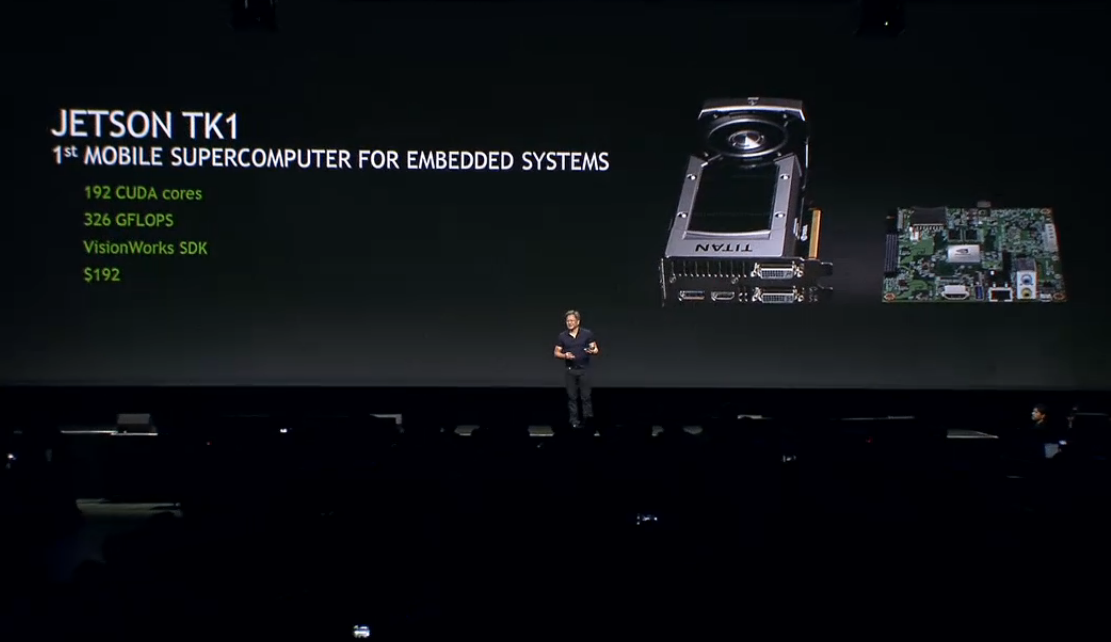
And for those who need a supercomputer now: Nvidia also announced its next-generation Titan card, the GeForce GTX Titan Z, starting at a whopping $2,999. Nvidia also announced what it calls the Iray VCA: a $50,000 virtual computing appliance for rendering images using modeled photons, to produce photorealistic images at up to 60 times the speed of today’s Nvidia-powered workstations. Finally, Nvidia announced the $192 Jetson TK1, an embedded development board to take its Tegra K1 to robots and computer vision, and disclosed the name of its next-generation Tegra chip, dubbed Erista.
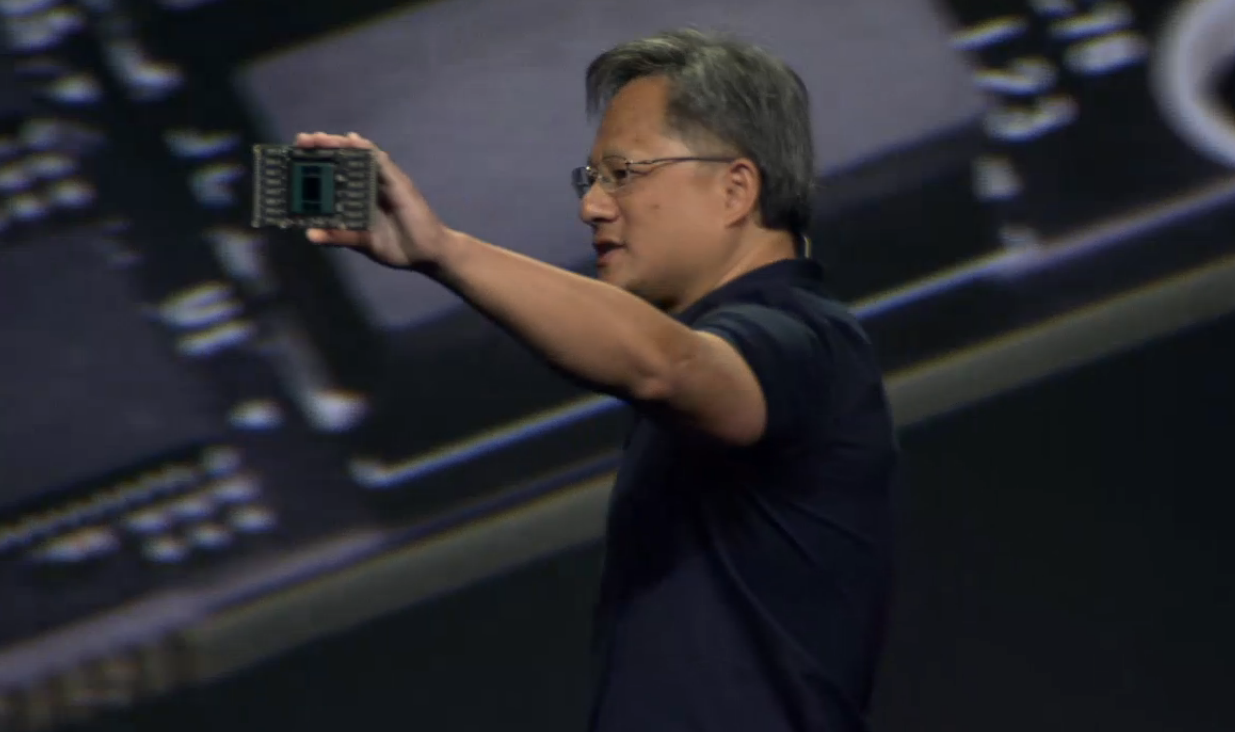
Nvidia chief executive Jen-Hsun Huang holds up a Pascal processor module.
Nvidia will ship the Pascal processor in 2016, Nvidia chief executive Jen-Hsun Huang said during the keynote address of its GPU Technology Conference, which focuses on the application of GPUs in computational problems. The conference originally was predicated on Nvidia’s CUDA programming language, which allowed scientists to program a GPU much like a computer.
It's unclear how much Nvidia's work, as evidenced by the GPU Technology Conference, contributes to Nvidia's bottom line. But Nvidia has consistently seen growth for in its high-end, high-margin GPUs for the desktop and workstation, which has been partially offset by declines in PCs and notebooks. And problems that Nvidia can solve with its supercomputer GPUs can trickle down into the PC.
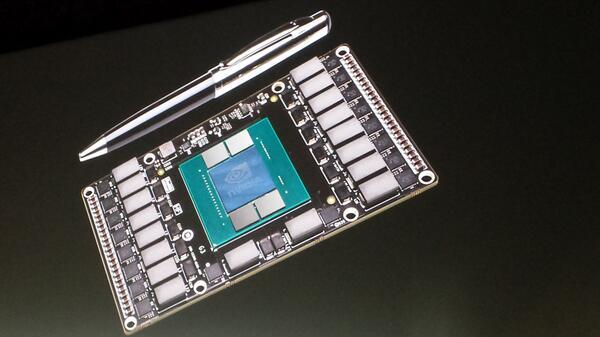
The Nvidia Pascal module.
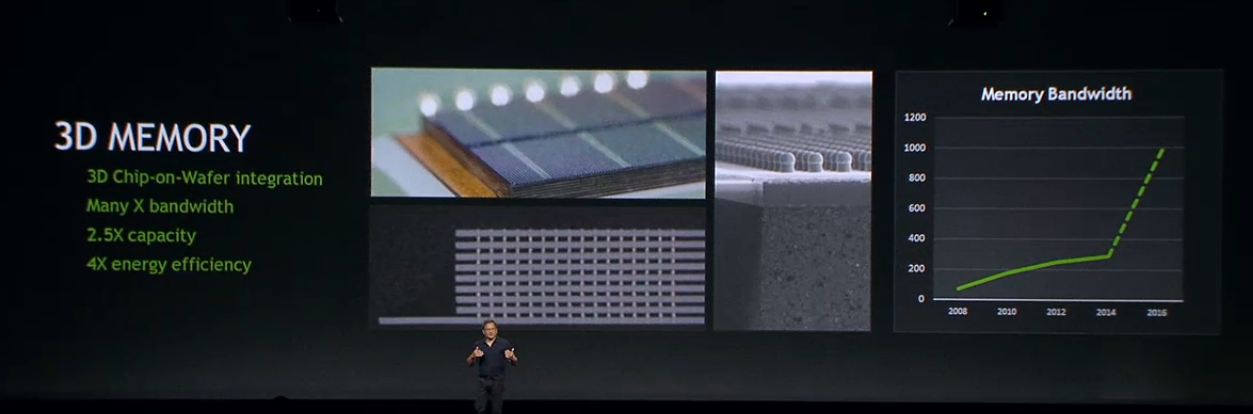
And Nvidia faces a thorny one. The problem, as Huang explained it, is relatively simple to express: GPUs are among the biggest chips ever created, but the demands for increasing GPU performance are unceasing. Accessing the memory used as a scratchpad for GPU computations can be improved by using a wider bus interface, but that adds more pins—and there can be a physical limit to how many pins can surround a chip. Simply forcing more data through those pins at higher and higher clock speeds increases the power consumed—and the heat produced—to unmanageable levels.
The answer, Huang said, was a twofold solution: NVLink, a replacement for PCI Express, which will offer between five and 12 times the performance of PCI Express; and the 3D interface, which will stack memory and other chips on top of one another, running via wires through the chips and the substrate to save space. The latter solution will help push memory bandwidth to 1000 times where they are now, Huang said.
The module that Nvidia built to house the Pascal chip architecture is one-third the size of a typical PCI Express module, Huang said. A new connector will allow it to be plugged into the motherboard, Nvidia said.
NVLink was codeveloped with IBM, and will incorporated into the OpenPower architecture that IBM is spearheading, Nvidia said. NVLink will be used not only to connect a GPU to the motherboard, but also to connect GPUs to each other, with improvements of up to 5X in terms of GPU to GPU scaling, Huang said.
Likewise, scaling is one of the problems that the new 3D architecture will help solve. Nvidia’s existing Kepler architecture already provides 288 Gbytes/s of memory bandwidth, according to Huang, but that too will inevitably increase over time. By stacking memory and other chips on top of one another, “in a couple of years we’re going to take bandwidth to a whole new level,” Huang said.
The idea is to use these GPUs to not only solve big-data simulations of weather, economics, and other computationally intensive problems, but also render images photorealistically. And the next step, as Huang said, was to combine both: for example, Nvidia sent engineers to take high-dynamic range photos of the stage itself, then added a realistic car model in the center, and moved the “camera” about to explore it.
Combining realistic graphics with a dynamic scene has typically been the provenance of CGI movies, but that has also moved from the big screen to the computer monitor. Huang showed off a demonstration of the next-generation Unreal Engine 3 running on top of the new GeForce GTX Titan Z that looked, in places, completely real. But there’s obviously a price: the Titan Z will cost $3000, although it will provide 5760 CUDA cores with two Kepler cores inside of it, 12GB of memory, and 8 teraflops of computing power. Oh, and it will consume 2000 watts by itself.
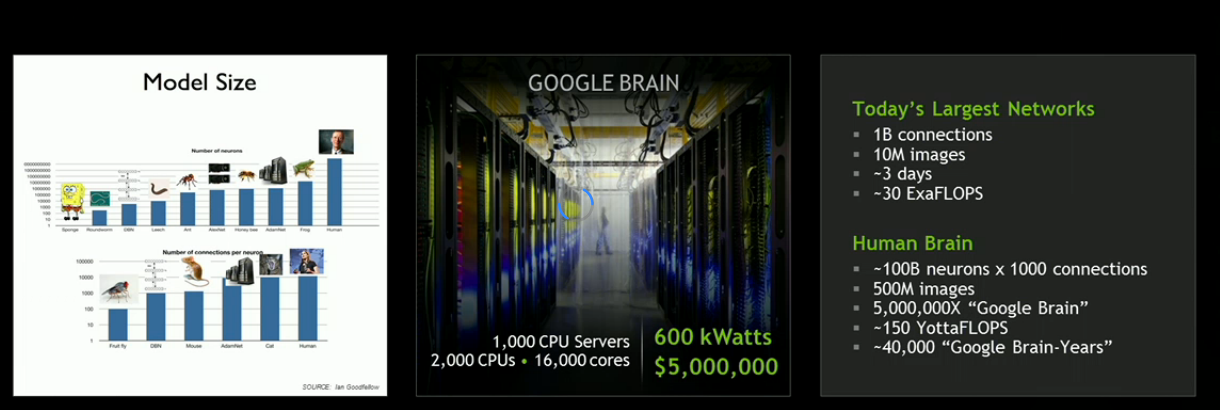
Pairing three of those GPUs together, Huang said, would provide the computational power of the “Google Brain,” the company’s effort to model the human brain that originally used a cluster of 16,000 computers. Just three GTX Titan Zs could be used instead, Huang said.
The Nvidia iRay VCA.
And if that’s not enough, Nvidia has an Iray VCA to offer you. Essentially, the VCA is a remote server designed as a “render farm” for companies, taking a scene and rendering it as quickly as possible. The technology uses what Nvidia calls “Irays,” modeling photons that fly though the air, bouncing off objects and being absorbed by them. Each VCA contains 8 GPUs for a total of 23,000 CUDA cores, which can access 12 Gbytes of memory per VCA. Each VCA runs on top of mobile graphics packages like Maya and 3DS Max. “What would take an hour to render, now takes a minute,” Huang said.
Nvidia's Tegra roadmap now includes the "Erista" chip.
Each Iray can be tied to others, using Nvidia software to connect them together and run them in parallel. Nvidia combined 19 iRays together to produce the equivalent of a petaflop—that's equivalent to the fastest supercomputer in the world, six years ago, Huang said.
The Nvidia Jetson TK1.
Finally, Nvidia showed off the Jetson TK1, an embedded module that takes theTegra K1 Nvidia announced at CES and brings it to the mobile space. Eventually, chips like the Tegra K1 and future iterations, like the Erista, will be the computational engine of Audi’s self-driving cars and more.
According to Huang, Nvidia's chips are all predicated on the CUDA technology Nvidia unveiled a few years ago. Can the company successfully expand beyond the PC? If you ask Huang, it's already happening.
Finally we have a New Titan on the market the GTX Titan Black, this card will definitely live up to its name. All we have to do now is wait until it hits Australia shore. Below is a benchmark and a write up from NVIDI.
When we launched GTX TITAN almost a year ago, it kickstarted the personal supercomputing revolution.Based on the same Kepler technology that powered Oak Ridge National Laboratory’s TITAN supercomputer, GTX TITAN was a beast.With extreme performance for gamers, double precision for CUDA developers, and a supercomputer-inspired design, GTX TITAN quickly became the GPU every gamer wanted to own. But that was so 2013. Today, we’re introducing the all-new 2014 version—TITAN BLACK. Featuring the same full GK110B chip configuration found in the GTX 780 Ti, TITAN BLACK delivers a staggering 5.1 Teraflops of computing performance per card. Double down by sliding two GTX Titans into your PC and you can take advantage of a total of 5,760 cores for even more performance.. Each TITAN BLACK also supports up to four displays per card—two DVI, one HDMI and one DisplayPort—perfect for large scale displays or multi-monitor configurations. Like the original, this new behemoth features a design that evokes the spirit of a supercomputer and the enormous capability within. If you’re looking for a guaranteed win, bet on black. TITAN BLACK, available today for $999us. - See more at: http://blogs.nvidia.com/blog/2014/02/18/bet-on-black-titan-black/#sthash.vGzZfD0B.dpuf
The GTX 750 and GTX 750Ti is an awesome little card for its price it is something I would stick in my media steam box/media centre. It will be interesting to see if the new maxwell GPU will work with Hackintosh, this will be tested as soon as I can get my hands on one.
Feeling a little lonely this weekend and want something to do? GET Steams weekend deal Make Love Not War. Two amazing games slashed to 50% off is definitely worth adding to your collection. These games do not only look spectacular but gameplay is addictive too.
Dual AMD FirePro™ D-Series GPUs power the graphics in the new Mac Pro and deliver state-of-the-art performance across the board. Available with 2GB, 3GB or 6GB of dedicated VRAM and up to 2048 stream processors and 7 teraflops of powerful graphics performance. You’ll be able to do things like seamlessly edit full-resolution 4K video while simultaneously rendering effects in the background — and still have enough power to connect up to three high-resolution 4K displays.
The new Mac Pro is available with three new AMD FirePro™ GPUs:
Dual AMD FirePro™ D300 graphics processors with 2GB of GDDR5 VRAM each
1280 stream processors
256-bit-wide memory bus
160GB/s memory bandwidth
2 teraflops performance
Dual AMD FirePro™ D500 graphics processors with 3GB of GDDR5 VRAM each
1526 stream processors
384-bit-wide memory bus
240GB/s memory bandwidth
2.2 teraflops performance
Dual AMD FirePro™ D700 graphics processors with 6GB of GDDR5 VRAM each
2048 stream processors
384-bit-wide memory bus
264GB/s memory bandwidth
3.5 teraflops performance
Video editing: 4K performance that’s nothing short of spectacular. Work pixel-for-pixel in 4K, thanks to dual AMD FirePro™ D-series GPUs in the Mac Pro — delivering the breathtaking capability to run three streams of 4K video at once. Combine that with the power to drive up to three 4K displays, process effects in real time and even edit 4K multicam clips, and you have a video editing powerhouse.
3D modeling and animation: The power to work with even the largest models. Dual AMD FirePro™ D-series GPUs — standard in every Mac Pro — provide up to 12GB of video memory, with up to 528GB/s of memory bandwidth for manipulating complex models with massive geometry and large textures. Work with your models at a whole new level of detail, speed and responsiveness. Apple Mac Pro works with OpenGL 4.1 in OS X Mavericks to support advanced features like tessellation shaders.
Photography: Edit your images in 4K. With the new AMD FirePro™ D-Series GPUs in the Mac Pro and powerful multiple-display support in OS X Mavericks, you can work with an image full screen on one display while you work with your photo browser on another. Connect a 4K display — with more than 8 million pixels — and see your photos in more detail than ever before while powerful AMD FirePro™ GPUs let you fly through edits, filters and effects.
GPU computing with OpenCL™. OpenCL™ lets you tap into the parallel computing power of modern GPUs and multicore CPUs to accelerate compute-intensive tasks in your Mac apps. Use OpenCL™ to incorporate advanced numerical and data analytics features, perform cutting-edge image and media processing and deliver accurate physics simulations. When coupled with the dual workstation-class AMD FirePro™ S-series GPUs with up to 4096 stream processors and 12GB of fast GDDR5 memory, OpenCL enables your applications to harness up to 7 teraflops of computational power.
AMD Eyefinity technology: Your data. In tremendous detail. The ability to run up to three 4K displays lets you visualize every detail of your data in new and exciting ways. That’s nearly 25 million pixels at your command.
RDT is coming out with 4 fixed price home theatre bundles. These home theatre builds are going to be spectacular and will give you the best viewing experience possible, Using XMBC the best customisable Home Theatre experience.
You can use your phone to control XMBC right from your couch giving you less clutter with remotes. The easy of use and having thousands of songs, tv shows, movies at your finger tips will simply give you a better than experience than cable TV and free to air.
Nvidia already owns the single-GPU performance crown, having plucked it back from the competition with the release of the GeForce GTX 780 Ti graphics card two months ago after AMD snatched it from atop the GeForce GTX Titan’shead. Now that it’s back where Nvidia feels it rightfully belongs, the GPU maker has no plans of letting it go any time soon and will defend its crown with the upcoming launch of the GeForce GTX Titan Black Edition and dual-GPU GeForce GTX 790 video cards.
According to VideoCardz, the updated Titan will flex the same GPU as the GTX 780 Ti but with higher double precision computing performance (more FP64 CUDA cores). It will also have 6GB of onboard GDDR5 memory, which is twice as much as the GTX 780 Ti, 2,880 CUDA cores, 240 TMUs, and 48 ROPs. No word on exactly when it will be released, just that it’s likely coming sometime next month and is expected to cost around $1,000 MSRP.
The Titan Black Edition won’t replace the GTX 780 Ti in performance, which is still the preferred card among gamers because of its price tag (it’s several hundred dollars less than a Titan). However, those looking for a dual-GPU card will get their wish in March with the launch of the GTX 790.
VideoCardz warns that it wasn’t able to verify the specs but believes it will ship with two 28nm GK110 GPus, two 2,496 CUDA-packed processors for 4,992 total, 416 total TMUs, 80 total ROPs, and 10GB of GDDR5 on a 320-bit bus. This one is also expected to retail for $1,000.
Over the past month the R9 290X's has had its release of the aftermarket cooling cards from each brand. This is certainly a refresh as the reference card was loud and hot. My way of tackling that issues was pull the card apart and liquid cool it.
For those who are to scared to water cool you can now have peace of mind and purchase an incredible graphics card, with amazing performance for the price.
Although we have seen a price hike since Bit-coin Mining become popular, the cards should start to go down the the price they should be.
Today I finished building a sweet gaming machine The RDT's Toxic Build, this build is a gamer's delight running the New Sapphire R9 280X Toxic edition. This graphics card is simply a pleasure to look at and runs incredibly smooth. Below are a few Photos of the build. If interested in purchasing this build please contact RDT.






 Powering graphics for the new Apple Mac Pro


