Yes it is true the amazing GeForce GTX Titan Z is here in Australia and available from today, this card is just built for the best. If you have enough money I would definitely be laying it down for this bad boy. It's current price is at $3,699 AU which will definitely scare a few of you off. This card is aimed at people who want performance and aren't afraid to spend, rendering on this card will make anything else you own look like dirt. The amount of work that has gone into this card is incredible and it really shows in its performance.
RDT is coming out with an number of workstation grade and performance grade machines soon after Computex and E3 have finished.
A week ago it was reported that Nvidia Corp. and its partners would finally release its new dual-chip flagship graphics card – GeForce GTX Titan Z – on the 8th of May. As it appears, no store in the world started to sell the most expensive consumer graphics board ever on Thursday and a rumour has it that the product has been postponed again.
Nvidia originally announced the GeForce GTX Titan Z at its annual GPU Technology Conference back in March. The product – powered by two extremely powerful GK110 graphics processing units, arguably the highest-performing GPUs ever made, along with 12GB of GDDR5 memory – was supposed to be a masterpiece from performance, engineering and feature-set points of view. It was also priced at whopping $3000 (£2330, €2835) without taxes, which would have made it a pride for the owners and a desire for all others.
But something went wrong. Over one and a half months after the formal announcement, the GeForce GTX Titan Z is still not available even from boutique PC makers.
Originally it was rumoured that the GeForce GTX Titan Z was to be released on the 29th of April, 2014. After the graphics board did not show up on that date, numerous web-sites reported that the launch was postponed to the 8th of May. Still, today, the dual-GPU made no show too. Moreover, there is no even unofficial information about a new launch date. ComputerBase.de web-site reports that the launch date was “shifted indefinitely”.
The reasons for the delay are unknown, but some believe that Nvidia wants to reconsider specifications of the product. When originally unveiled, the GeForce GTX Titan Z was supposed to be the highest-performing graphics card on the market with 8TFLOPS of maximum single-precision compute performance, which could justify its incredible price of $3000 (£2330, €2835). However, since then AMD rolled-out its Radeon R9 295X2 powered by two Hawaii XT GPUs that costs less than half the price and delivers nearly 11.5TFLOPS of compute performance. Given such a rival on the market, Nvidia reportedly took additional time to tweak clock-rates of the GPUs and memory as well as to polish its drivers.
Nvidia did not comment on the news-story.
Update: While there are mentions of the GeForce GTX Titan Z on select online auction web-sites, it does not look like the graphics boards are actually at hands of their sellers. For example, a number of people on Chinese auctions are selling Nvidia GeForce GTX Titan (or even something else, e.g., the GeForce GTX 690), but advertise it like the GeForce GTX Titan Z. There is also one person on Ebay, who is auctioning a GeForce GTX Titan Z 12GB graphics card without giving an exact delivery date, but estimates to ship it between the 1st and the 16th of July. LINK
RDT is now offering some amazing deals on workstation grade custom PC's. These work station builds are designed not only to last but to kick ass while doing it. RDT prides its self on offer quality at a fast pace and aims to keep all customers happy. Below is some specs of a sweet RDT build:
Intel Core i7-4930K 3.4GHz 6-Core CPU
32GB Corsair Dominator Platinum (4x8)
GeForce GTX Titan Black
1TB RAID 0 SSD's (Samsung EVO 500GB x 2)
6TB HDD Storage (WD Caviar Black 3TB x 2)
1000W Platinum PSU
Corsair H110 Liquid CPU Cooler
Noctua Silent Fans
Corsair Carbide Air 540 Case
All of these High end product will set you back: $6,599 AU (Includes Build Cost)
This machine is tailored for those of you who are Video, Graphics and Photography Professionals, requiring a PC that will power its way through rendering with ease.
For more information and Other tailored Builds Please Contact RDT:
AMD has came out with its new GPU, this top tier card will support two Hawaii chips with 2816 stream processors, 176 texture units, 512-bit memory bus and to top it off 8GB GDDR5 memory. Personally from this image above I sure do hope that this is not the final design it is hideous. I was hoping for something similar to the ASUS Posidion GPUs, allowing for Air/Water cooling. The chips will operate at up to 1018MHz clock-rate, whereas the memory will function at 5GHz effective rate.
From infomation gathered from neumerous sites it seems that the card is going to be a whomping 31cm in length. Meaning this card is not exactly going to fit into everyones case. The price point is set at approxamatly $1,499 US, which is similar to the GTX Titan Black.
The word on the street is there is a new GPU on it's way and it is only going to set you back $2,999 US. It's the GTX Titan Z.
Read about it below from PCWorld
On Tuesday, Nvidia announced its next GPU, called Pascal, which will dramatically rearchitect the traditional graphics card by replacing the PCI Express bus and combining it with a new 3D memory technology.
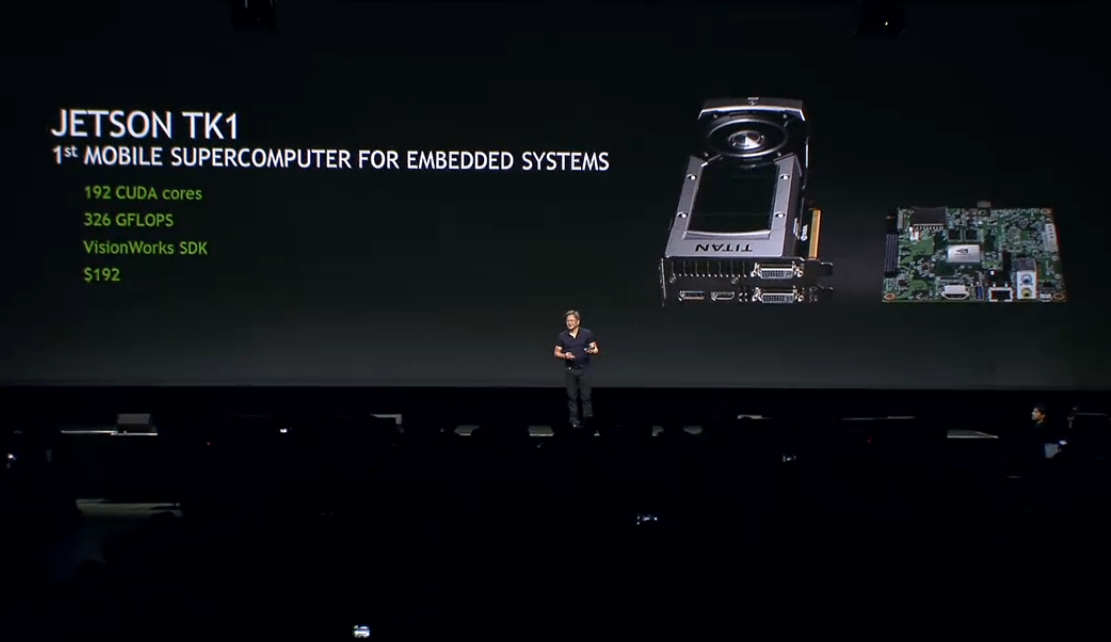
And for those who need a supercomputer now: Nvidia also announced its next-generation Titan card, the GeForce GTX Titan Z, starting at a whopping $2,999. Nvidia also announced what it calls the Iray VCA: a $50,000 virtual computing appliance for rendering images using modeled photons, to produce photorealistic images at up to 60 times the speed of today’s Nvidia-powered workstations. Finally, Nvidia announced the $192 Jetson TK1, an embedded development board to take its Tegra K1 to robots and computer vision, and disclosed the name of its next-generation Tegra chip, dubbed Erista.
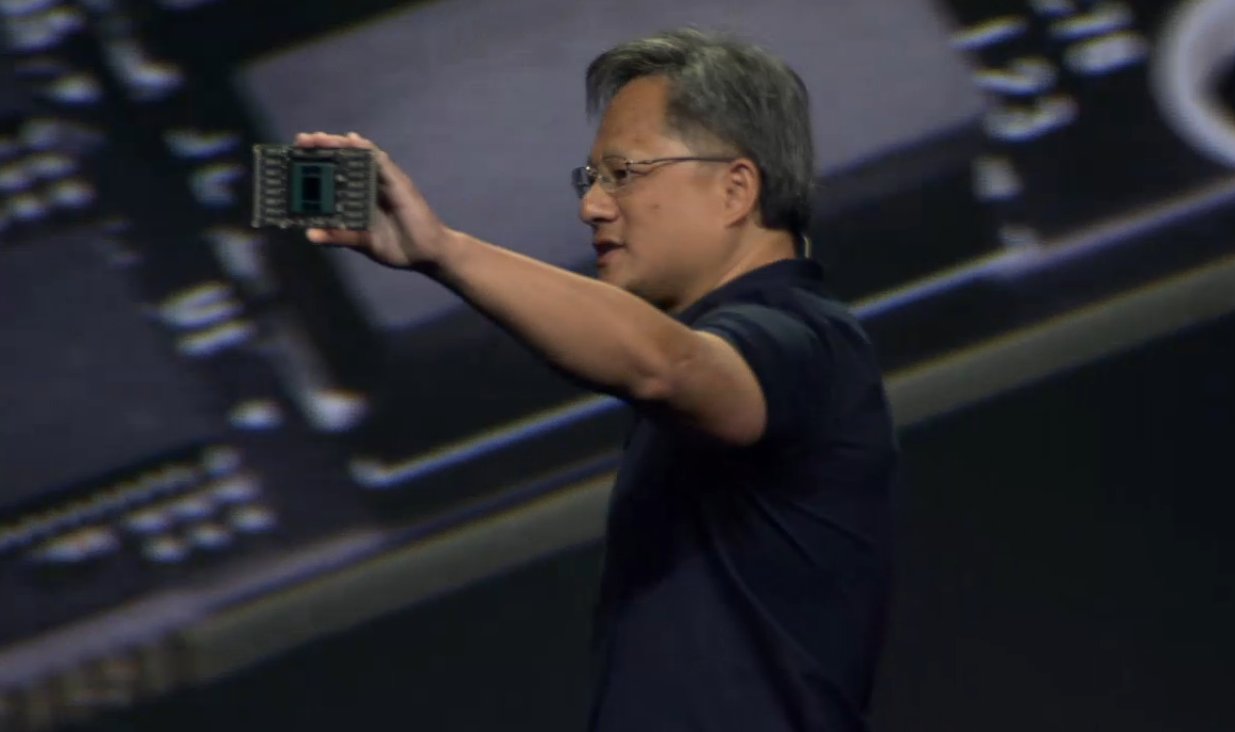
Nvidia chief executive Jen-Hsun Huang holds up a Pascal processor module.
Nvidia will ship the Pascal processor in 2016, Nvidia chief executive Jen-Hsun Huang said during the keynote address of its GPU Technology Conference, which focuses on the application of GPUs in computational problems. The conference originally was predicated on Nvidia’s CUDA programming language, which allowed scientists to program a GPU much like a computer.
It's unclear how much Nvidia's work, as evidenced by the GPU Technology Conference, contributes to Nvidia's bottom line. But Nvidia has consistently seen growth for in its high-end, high-margin GPUs for the desktop and workstation, which has been partially offset by declines in PCs and notebooks. And problems that Nvidia can solve with its supercomputer GPUs can trickle down into the PC.
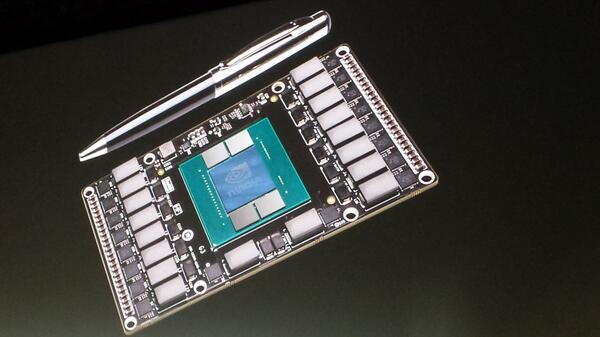
The Nvidia Pascal module.
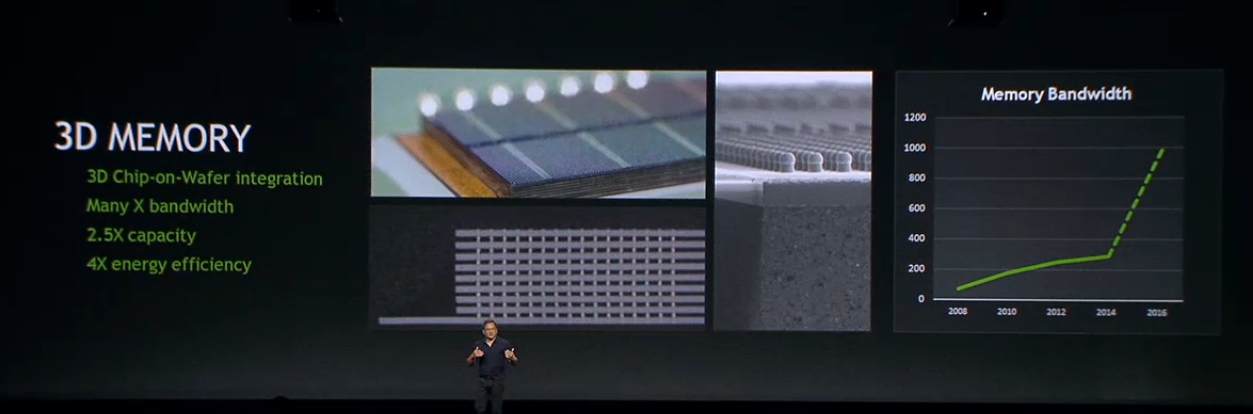
And Nvidia faces a thorny one. The problem, as Huang explained it, is relatively simple to express: GPUs are among the biggest chips ever created, but the demands for increasing GPU performance are unceasing. Accessing the memory used as a scratchpad for GPU computations can be improved by using a wider bus interface, but that adds more pins—and there can be a physical limit to how many pins can surround a chip. Simply forcing more data through those pins at higher and higher clock speeds increases the power consumed—and the heat produced—to unmanageable levels.
The answer, Huang said, was a twofold solution: NVLink, a replacement for PCI Express, which will offer between five and 12 times the performance of PCI Express; and the 3D interface, which will stack memory and other chips on top of one another, running via wires through the chips and the substrate to save space. The latter solution will help push memory bandwidth to 1000 times where they are now, Huang said.
The module that Nvidia built to house the Pascal chip architecture is one-third the size of a typical PCI Express module, Huang said. A new connector will allow it to be plugged into the motherboard, Nvidia said.
NVLink was codeveloped with IBM, and will incorporated into the OpenPower architecture that IBM is spearheading, Nvidia said. NVLink will be used not only to connect a GPU to the motherboard, but also to connect GPUs to each other, with improvements of up to 5X in terms of GPU to GPU scaling, Huang said.
Likewise, scaling is one of the problems that the new 3D architecture will help solve. Nvidia’s existing Kepler architecture already provides 288 Gbytes/s of memory bandwidth, according to Huang, but that too will inevitably increase over time. By stacking memory and other chips on top of one another, “in a couple of years we’re going to take bandwidth to a whole new level,” Huang said.
The idea is to use these GPUs to not only solve big-data simulations of weather, economics, and other computationally intensive problems, but also render images photorealistically. And the next step, as Huang said, was to combine both: for example, Nvidia sent engineers to take high-dynamic range photos of the stage itself, then added a realistic car model in the center, and moved the “camera” about to explore it.
Combining realistic graphics with a dynamic scene has typically been the provenance of CGI movies, but that has also moved from the big screen to the computer monitor. Huang showed off a demonstration of the next-generation Unreal Engine 3 running on top of the new GeForce GTX Titan Z that looked, in places, completely real. But there’s obviously a price: the Titan Z will cost $3000, although it will provide 5760 CUDA cores with two Kepler cores inside of it, 12GB of memory, and 8 teraflops of computing power. Oh, and it will consume 2000 watts by itself.
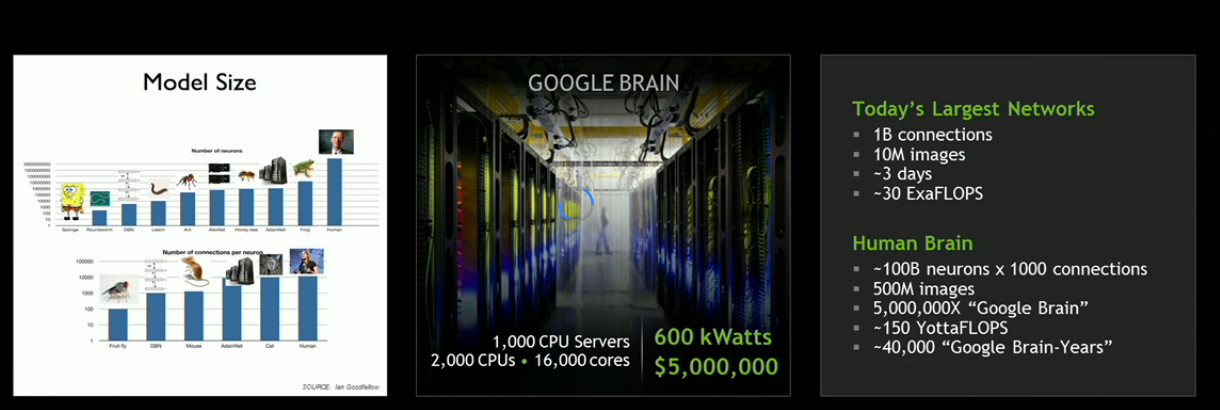
Pairing three of those GPUs together, Huang said, would provide the computational power of the “Google Brain,” the company’s effort to model the human brain that originally used a cluster of 16,000 computers. Just three GTX Titan Zs could be used instead, Huang said.
The Nvidia iRay VCA.
And if that’s not enough, Nvidia has an Iray VCA to offer you. Essentially, the VCA is a remote server designed as a “render farm” for companies, taking a scene and rendering it as quickly as possible. The technology uses what Nvidia calls “Irays,” modeling photons that fly though the air, bouncing off objects and being absorbed by them. Each VCA contains 8 GPUs for a total of 23,000 CUDA cores, which can access 12 Gbytes of memory per VCA. Each VCA runs on top of mobile graphics packages like Maya and 3DS Max. “What would take an hour to render, now takes a minute,” Huang said.
Nvidia's Tegra roadmap now includes the "Erista" chip.
Each Iray can be tied to others, using Nvidia software to connect them together and run them in parallel. Nvidia combined 19 iRays together to produce the equivalent of a petaflop—that's equivalent to the fastest supercomputer in the world, six years ago, Huang said.
The Nvidia Jetson TK1.
Finally, Nvidia showed off the Jetson TK1, an embedded module that takes theTegra K1 Nvidia announced at CES and brings it to the mobile space. Eventually, chips like the Tegra K1 and future iterations, like the Erista, will be the computational engine of Audi’s self-driving cars and more.
According to Huang, Nvidia's chips are all predicated on the CUDA technology Nvidia unveiled a few years ago. Can the company successfully expand beyond the PC? If you ask Huang, it's already happening.