Intel Corp. plans to release a rather broad range of microprocessors based on the Skylake micro-architecture for mobile computers next year, according to a new media report. The upcoming central processing units (CPUs) will address all kinds of mobile devices, including tablets, 2-in-1s, mainstream notebooks as well as high-performance laptops.
As expected, the family of mobile central processing units powered by the Skylake micro-architecture will include three major lines: Skylake-Y for ultra-low-power devices, Skylake-U for mainstream notebooks and Skylake-H for high-end workstation- or gaming-class laptops. Each line will include from four to 15 models, which means that there will be at least 19 different mobile Skylake CPUs net year (four SKL-Y + four SKL-H + 15 SKL-U), reports CPU World.
General specifications of the new chips will look as follows:
- Skylake-Y (SKL-Y): Core M product line. The chips will feature 2 cores with Hyper-Threading, GT2-class graphics, on-package core-logic set, 3MB or 4MB cache, vPro and TurboBoost technologies. TDP: 4W or lower.
- Skylake-U (SKL-U): Core i7, Core i5, Core i3, Pentium and Celeron product lines. The chips will feature 2 cores with or without Hyper-Threading, GT1/GT2/GT3/GT3e-class graphics, on-package core-logic set, 2MB, 3MB or 4MB cache, vPro and TurboBoost technologies (on select models). TDP: 15W or 28W.
- Skylake-H (SKL-H): Core i7, Core i5, Core i3 product lines. The chips will feature 4 cores with Hyper-Threading (Core i3 will feature 2 cores), GT3/GT4-class graphics with or without embedded cache, large L3 caches, vPro and TurboBoost technologies (on select models). TDP: 35W or 45W.
Note: It is unclear which chips support DDR3/DDR3L/LPDDR3 and which also support DDR4.
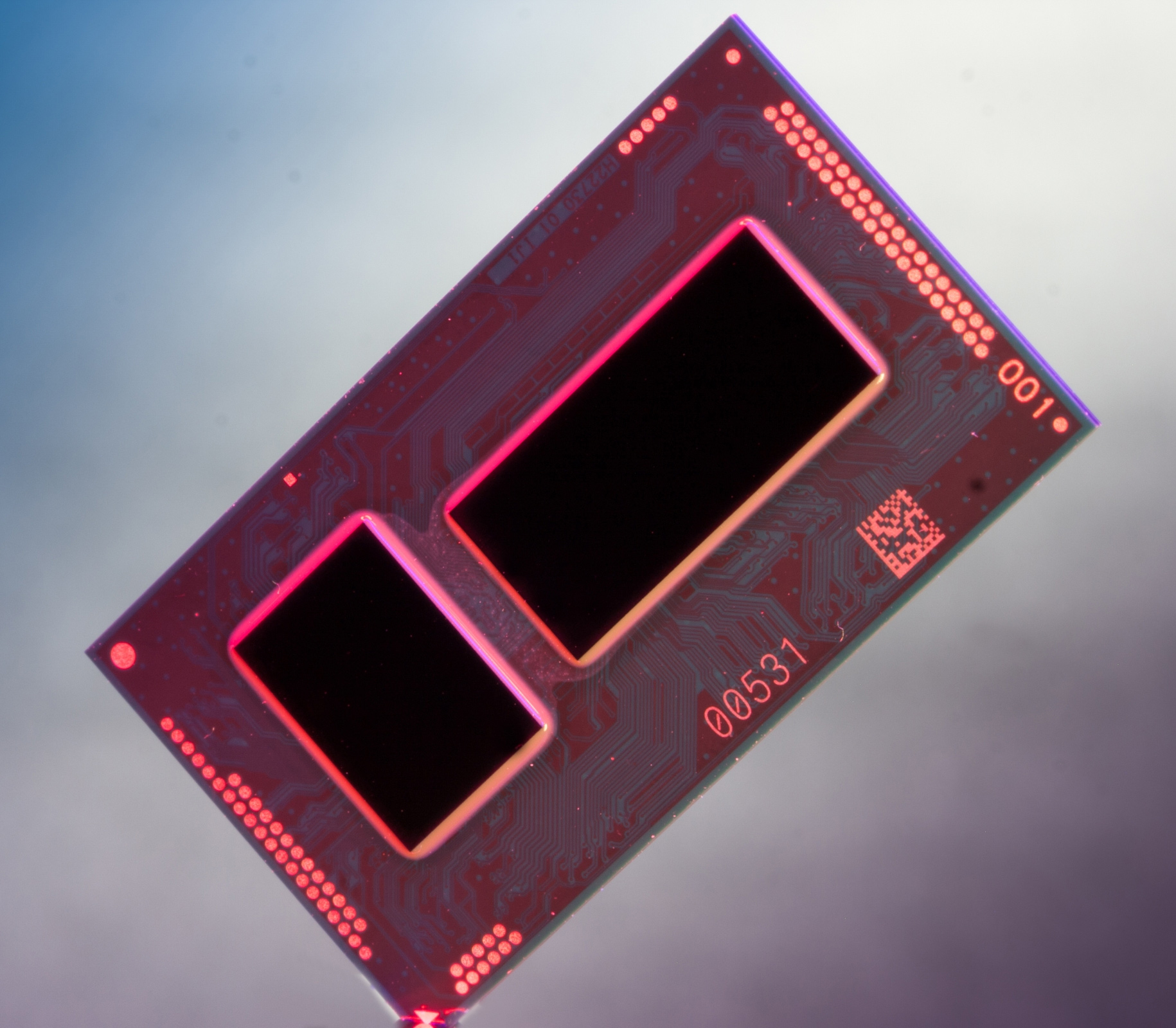 Intel Core M “Broadwell-Y” processor. Image for illustrative purposes only.
The broad family of mobile Skylake microprocessors indicates that Intel plans to ramp up production of Skylake chips pretty quickly and therefore there will be a lot of systems featuring the latest processors in 2015. Unfortunately, there are no launch details or launch dates for Skylake CPUs.
Central processing units based on Intel’s Skylake micro-architecture are expected to feature considerably improved graphics, a bunch of special-purpose accelerators (e.g., HEVC and VP9 hardware decoders) and support such technologies as AVX 3.2 (512-bit instructions), SHA extensions (SHA-1 and SHA-256, secure hash algorithms), MPX (memory protection extensions), ADX (multi-precision add-carry instruction extensions) and other innovations.
The next-gen Skylake client platform due in 2015 will also be accompanied with numerous connectivity and I/O options, such as Snowfield Peak (Wi-Fi, Bluetooth), Douglas Peak (WiGig, Wi-Fi, Bluetooth), Pine Peak (WiGig), Alpine Ridge (Thunderbolt 3.0 with 40Gb/s transfer rate), Jacksonville Ethernet, next-generation XMM726x-series WWAN 4G/LTE modem and so on. Mobile platforms based on Skylake will support Rezence wireless charging.
Source: http://www.kitguru.net/components/cpu/anton-shilov/lineup-of-mobile-skylake-chips-to-feature-tens-of-models-in-2015/
If you want to contact RDT please feel free to call between the hours of 9am-8pm AEST. deon@robertsondt.com Ph: 0426279566 or visit https://www.facebook.com/rdtaus


